Thursday, October 27, 2011

DAHILAYAN ADVENTURE PARK


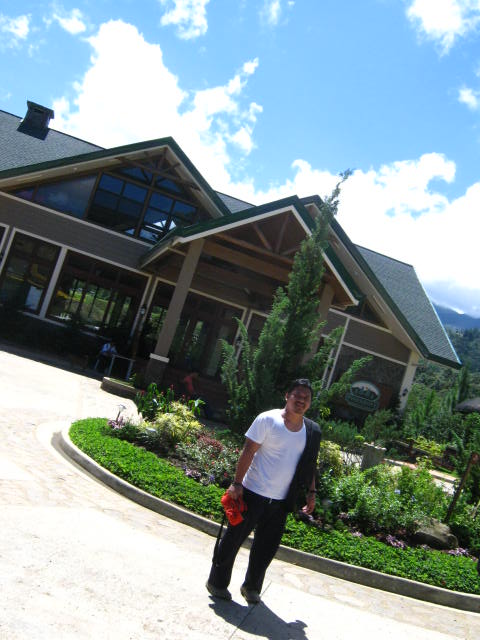
Visitors to  the Dahilayan Adventure Park are welcomed by this Swiss-alps styled chalet (sans the SNOW) which serves as the main lodging house (Pine Grove Mountain Lodge) for overnight guests. For P600, one can already sample what had been advertised as ASIA'S LONGEST DUAL ZIPLINE (whatever that means! tsk!), that is, two rides on both the 320-meter and 840-meter ziplines.  In a matter of seconds, one gets a real thrill being suspended and 'flying' over the beautiful canyons and gorges of Dahilayan.  A warning though:  one needs to be 250lbs or less to take the rides.  We all qualified!!!!


Of course, safety gears are a must before taking the rides.  Michael Casinillo (above) poses before a list of "do's" and "dont's."  Just a few seconds before their ride, Michael and Alain Nocete (below left) flash their most eager smiles.  Yaaaaay!  Look at their eyes!  Tsk!  Father Frank (below right), on the other hand shows us the length of this first ride ... that is, from one point to that beyond the building behind him.  Fr. Rey Raluto gives the first batch of zip-line riders some words of encouragement.  And off ... they went.  Whew!  Done in a few seconds!  Next ride please!


This batch consists of Argie Deliso (CDO), Bernie Narvasa (Butuan) and Romnick Cutar (Tagum).  Hey! Where are the others?


Are those BODY BAGS!  For the 840-meter zipline, one needs to don these over-sized suits ... that will eventually be attached to more (and hopefully STRONGER) straps and harnesses. The idea is for the body to glide like a bird, with the entire body outstretched and facing down to enjoy the view.  One needs to note however that the laws of Physics apply, that is, a heavier object gathers greater momentum and thus moves at a faster speed.  Be forewarned! Whew!


TRIBAL BEAUTIES


For its semestral break outing this year, the SJVTS San Lorenzo sub-community took Bukidnon by STORM.  Notwithstanding, the mega-excavations of the highway (what highway!!!!), the thick mud and gigantic potholes, the troop managed to enjoy and make the most of what may have been an ultra-disheartening and tiring trip.  No trace of disappointment however can be gleaned from each one's faces as the camera clicked and clicked especially with these "tribal beauties"  in the background.  What a respite to take a break from the bumpy ride indeed as we got off the vans for photo ops with these bigger than life-sized statues of tribal women welcoming visitors to Impasug-ong, Bukidnon.  The 3-day trip also brought the group to Valencia, Malaybalay, Dahilayan and Kumakay, Bukidnon.  All's well that ends well!

"Walang HIMALA" says James Cabungcal (Butuan)


Joven Jabla enjoying the company of the ladies.
 

REXONA wont let Melvin Abejero down.


A Muslim Imam joined the group? 


Monday, October 24, 2011

ALL OUR PAINS WILL EVENTUALLY END

Thirtieth Sunday in Ordinary Time
Reflections on Exodus 22:20-26  /   1 Thessalonians 1:5c-10    /   Matthew 22:34-40

ALL OUR PAINS WILL EVENTUALLY END
by Frank D.B. Savadera, SJ

The other day, we saw flashed in the newspapers the arrest and eventual execution of Libyan President Moammar Khaddafi. Who is he for us?  I've searched the internet and YouTube and realized that he figured significantly in the diplomatic peace talks between the Philippine government and our Muslim brothers here in Mindanao.  We often times hear about the TRIPOLI AGREEMENT (Tripoli – the capital of Libya where Khadaffi was former president).  There had been videos of then First Lady Imelda Marcos visiting Libya in the 1970s to secure the support of Khadaffi to MEDIATE the peace talks between the Philippine government and the Muslim separatist movement here in Mindanao.  Apparently enamored by the beautiful Imelda Marcos, Khaddaffi agreed to support the peace talks in the Philippines. 

This week Khaddafi is dead.  Not that he died simply of a sickness ... he died violently at the hands of his own countrymen.  Apparently, he was most hated.  Apparently, he had caused a lot of misery among his own people.  Reportedly, he himself was blood-thirsty and ordered the execution of many of his opponents.  The video on YouTube was very graphic:  one sees the bloodied Khadaffi being paraded around by gun-toting soldiers and civilians.  There was a lot of noise in the background.  He was being pushed against the hood of a truck ... and apparently, in his own language was begging that the soldiers do not kill him.  The video went very fast ... and the next time you see ... a gun was pointed at him ... the gun was fired ... not once but a countless times.  And the next video showed the lifeless president of the former Libyan president lying dead on the ground.

What reflections from our readings apply to the historical event mentioned above?

Firstly, we say that we as Catholic Christians do not and must not support ALL FORMS OF VIOLENCE.  In fact, we must even express openly our displeasure and strong rejection of violence inflicted against another person ... regardless of what that person had committed.  If you explore Youtube, there are other videos of thieves, robbers and snatchers caught red-handed by townfolks ... and much like the video on Khadaffi ... were mugged ... as in, bugbog-sarado.   And may we repeat, as you may in the future find yourself in a similar situation,  we as Catholic Christians do not and must not support ALL FORMS OF VIOLENCE. 

What we support however, is the END TO ALL VIOLENT REGIMES.  ALL OUR PAINS ... much like everything in this world ... WILL EVENTUALLY END ... because God listens to all our cries.   We are assured of this ... by our reading from the Book of Exodus:  “If  you wrong them and they cry out to me, I will surely hear their cry.” ALL OUR PAINS WILL EVENTUALLY END ... BECAUSE GOD LISTENS TO ALL OUR CRIES.  If God listens to our CRIES ... then we should have no problem CRYING IN FRONT OF THE LORD.  Often, we cry about our problems.  QUESTION:  DO WE CRY ABOUT THEM IN FRONT OF THE LORD?  God may seem quiet ... but in the quiet ... can we be assured that he nevertheless LISTENS TO US ... God surely hears our cries.  

HAVE YOU CRIED ABOUT PEOPLE WHO OPPRESS YOU ... WHO PUT YOU DOWN ... WHO CAUSED YOU SO MUCH TROUBLE AND PAIN?  Or perhaps, we may have caused the suffering of people ourselves ... that we may have caused others so much pain ... that we may have dropped a word that caused anxiety for another.  Or do we even wish and deliberately plan to cause pain against another?  If we say that God listens to the cries of his people ... much like the case of Khadaffi ... we would wish to believe that he will deal most appropriately against wrong-doers in society.  ARE YOU AN EVIL DOER?  Believe it or not ... even for us who regularly attend Sunday masses ... some of us ... and this we need to be personally honest ... we cause pain against others.  Thus, a warning had been set.  From Exodus again, Yahweh says:  “My wrath will flare up, and I will kill you with the sword; then your own wives will be widows, and your children orphans. IF GOD LISTENS TO THE CRIES OF HIS PEOPLE ... IF HE MOVES ALWAYS TO PROTECT THE OPPRESSED ... a warning thus for all of us:  Can we examine ourselves.  Do we contribute to the PAIN and MISERY of others? Whom have I hurt or continue to hurt?    

From St. Paul’s letter to the Thessalonians:  “You became imitators of us and of the Lord, receiving the word in great affliction, with joy from the Holy Spirit, so that you became a model for all the believers.   WE ARE ASKED TO BE MODELS FOR ALL BELIEVERS; WE ARE ASKED ALWAYS TO BE IMITATORS OF CHRIST in all our ways.  The GOSPEL therefore becomes more meaningful:  You shall love the Lord, your God, with all your heart, with all your soul, and with all your mind. This is the greatest and the first commandment. The second is like it: You shall love your neighbor as yourself. 

ALL OUR PAINS WILL EVENTUALLY END ... BECAUSE GOD LISTENS TO ALL OUR CRIES.  

GOD poses a warning for all of us EVIL DOERS (including myself).  Stop harassing the poor and the helpless ... pray that we do not become the cause of PAIN and DIFFICULTY for another person.

Lastly, be MODELS FOR ALL BELIEVERS.  The Gospel shows us how:  Love the Lord, your God, with all your heart, with all your soul, and with all your mind.   Love your neighbor as yourself. 


Monday, October 3, 2011

Trouble In The Lord's Vineyard

Twenty-Seventh Sunday in Ordinary Time 
Reflections on Isaiah 5:1-7 /   Philippians 4:6-9   /  Matthew 21:33-43

by Frank D. B. Savadera, SJ


There is trouble in the Lord’s vineyard.  According to Isaiah 5: “What more was there to do for my vineyard that I had not done?  There is bloodshed! a seething cry for justice! What EXASPERATION! Can we contemplate the seeming frustration of the landowner when he says: What more was there to do for my vineyard that I had not done?  

What troubles do we see in the Lord’s vineyard at this time? We read about the recent calamities in Luzon and news about parts of Manila sinking by a few centimeters every year.  Every so often,  there’s a new storm coming!  We also read about crimes associated with the youth.  There's this young teenager who killed his “so-called” friend with a gun ... inside a mall in Pampanga ... and this before shooting himself.   And kidnappings!  How are we allowing such troubles to affect/ not affect us?  God’s vineyard is supposed to produce good fruits. What prevents our situation/ context from producing “God’s desired results?”  The Gospel today tells us that the Kingdom of God will be taken from those who are not bearing fruit.  There is trouble in the Lord’s vineyard!  Can we allow ourselves to be disturbed by all these troubles and assert that all of must must work to assure that the Lord’s vineyard  produce good fruits ... real good fruits.  

Peace of mind (inner) and the quality of our prayer.  Amidst all the troubles we see and experience around us, how are we led ... all the more ... to pray and seek inner peace?  Saint Paul, in his letter to friends (Philippians ... his most loved community) speaks about a kind of peace ... the peace of God that surpasses all understanding.  When was the last time you’ve experienced such a kind of peace?  How much do we long for that kind of peace ... the kind of peace which according to Saint Paul ... that will guard our hearts and minds.   How sincerely do we long for inner peace?  Are we making such a request known to God? As Saint Paul suggests:  "Have no anxiety at all, but in everything, by prayer and petition, with thanksgiving, make your requests known to God." How is he assuring us to have  no anxiety at all?


Longing for peace in our communities.  How did UN-peace / trouble evolve in the Gospel?  The tenants of the vineyard were drawn to commit violence against their neighbor.  Why?  They wanted for themselves what did not belong to them. The vineyard’s produce belonged to the landowner.  The tenants simply didn’t want the owner of the land to benefit from the produce.  What are the things that we wish to possess for ourselves?  These, of course, need not be materials things.  Rather, these may mean all the things that we deem important   ... i.e., our reputation, our principles, our pride, our self-image, etc.  Often, being too protective of what we wish to possess for ourselves causes us to inflict violence upon others.  All the more, we must pray and seek peace not only within us but as well in our communities.  The advice of Saint Paul can translate to the peace that we can build in community:  “Whatever is true, whatever is honorable, whatever is just, whatever is pure, whatever is lovely, whatever is gracious, if there is any excellence and if there is anything worthy of praise, think about these things.” 

Thursday, September 29, 2011

Feast Of San Lorenzo Ruiz

by Frank Savadera, SJ

Who among us had experienced torture?  A story goes: a group of classmates were once penalized by thier professors for an unethical psychological experiment.  They asked for a volunteer; they brought the same student volunteer to a private place in Tagaytay ... and there ... they proceeded with the experiment.  They simulated “torture.”  The “game” was simple.  The volunteer played the role of a ‘political detainee’ and the experimenters acted as his torturers.  The torturers tied up the "prisoner," blindfolded him and gagged his mouth.  For an entire weekend, the so-called ‘torturers’ took turns making sure that their  “prisoner”  would not get any sleep.  They exposed their prisoner to all sorts of verbal abuse ... shouting at him and terrorizing him with false threats.  The torturers didn’t even give their prisoner the privilege of using the toilet for the entire duration of the experiment.  Exciting ba!   
   
Friends, today we remember the martyrdom of San Lorenzo Ruiz and companions.  As a Filipino, I couldn’t help but be proud opening my missal and finding San Lorenzo’s name included in the list of legitimate and recognized saints of the Catholic Church.  I find it also interesting that the first Filipino saint isn’t even a cleric or religious.  San Lorenzo also represents an even bigger number of saints and martyrs who suffered torture and religious persecution in 16th century Japan.

How was the experience of torture among these martyrs of Japan?  Beheading must have been the fastest, simplest and ‘painless’ way to go during the time of the persecution.  Our saints and martyrs of Japan, San Lorenzo included, suffered more than that for sure. Group killings were done by crucifixion or fire.  Some were tied to crosses and then pierced by soldiers. Some victims were tied to posts off shore at low tide. As the tide rose, if they renounced their faith, they would be freed. If not, they would drown. Some victims were hung over the volcanic wells of hot sulfur or doused with water from the hot springs.  Well documented was the torture of the pit. A victim was upside down for hours or even days with his or her head immersed in a pit filled with excrement and animal carcasses. A contemporary witness wrote: “The reverse hanging causes an indescribably terrible pain. Many Christians could not help but abandon their faith.”

The novel entitled SILENCE by Shusako Endo describes for us a different kind of psychological torture employed during the Christian persecution in Japan. This involved the use of the FUMIE or a special image of Christ or the Virgin Mary.  Suspected Christians were asked to step-on the FUMIE as a public form of renouncing their faith.  Many Christians – tired, exhausted and wasted after a period of torture ... couldn’t help but step on the FUMIE ... thereby formalizing their turning away from the faith.

Shusako Endo, the author talks about the life of a Jesuit priest named Father Ferreira who was then the vice-provincial of the Philippine Province at that time.  Father Ferreira was known to be a very holy man, a priest who exemplified real and true virtue.  Some people thought of him even as a “living saint.”   After ending his term in the Philippines, he found himself in Japan during the time of the persecution.  He may have met Lorenzo Ruiz, we are not sure.  To make the story short ... after undergoing severe physical torture at the hands of his persecutors ... Father Fereira was asked to stepped onto the Fumie ... an Image of the Sacred Heart of Jesus – as an indication that he would wish to renounce his faith and live.   Father Fereira stepped on the Fumie and apostacized.  

As a result, he promised not to practice his faith and donned the traditional Japanese garb.  He was eventually given a position in the government --- that of, the more difficult task of convincing Christians to turn away from the faith.  Some readers of Shusako Endo’s novel believe that Father Fereira symbolizes Christians who are externally pious yet shallow in faith.  Some however think that even after renouncing his faith, Father Ferreira served as a quiet yet vital witness to the faith at the time of persecution.  He may not have practiced his religion openly but his silent witness to the faith was thought of as extraordinary. Some readers of the novel even think that Father Ferreira suffered more than physical torture by choosing to live than die for the faith.

Friends today as we commemorate the martyrdom of San Lorenzo Ruiz and companions ... we remind ourselves that though we may not have opportunities or the privilege to go through violent forms of physical torture – we nevertheless are still called to witness to the faith.  While some ... our martyrs chose to die for the faith ... some if not most of us are called to LIVE for the faith.        


In our Gospel today, it says: “An argument arose among the disciples about which of them was the greatest.”   We salute San Lorenzo Ruiz and companions for their super great and exemplary example of martyrdom and dying for the faith.  We also find inspiration amongst us who are choosing to live each day --- growing in virtue (in a different form of martyrdom) to exemplify the same faith.   To live or die for the faith?  What is the greatest way?  Jesus himself said:  Whoever receives me receives the one who sent me.  

Thursday, September 15, 2011


Memorial of Our Lady of Sorrows 
Sharing in the Suffering of Our Lord
By Frank Savadera, SJ

Our feast today is dedicated to the spiritual martyrdom of Mary, Mother of God, and her compassion with the sufferings of her Divine Son, Jesus. 

Catholic tradition speaks of the so-called "Seven Sorrows of Mary," namely the following:
  The Prophecy of Simeon 
  Mary Meets Jesus on the Way to Calvary


The IMPASSIBILITY OF GOD principle asserts the FULL DIVINITY OF GOD and therefore, he must be beyond all forms of human emotions, including suffering.  He is the UNMOVED MOVER and as such NO MAN can prevail upon Him; He cannot be influenced by anyone; he cannot be swayed nor be made to do nor feel anything ... precisely because He is God. 

But stories in SCRIPTURES seem to reveal otherwise.  In Genesis, we see a God who is capable of expressing a certain GLADNESS:  He looked at his creation and says:  That is good!  How many times in the historical books of the Old Testament did Yahweh seem to be EMOTIONALLY involved bargaining with His people (i.e., if there are 50, 30, 20, 10 or 5 good people in Sodom/ Gomorrah ... then I can spare the entire city from destruction;  OR also sparing a king and withholding punishment after a time of fasting and sprinkling ashes on one’s head).  The apparent UNMOVED MOVER seemed to have been MOVED a countless times ... even in Scriptures. 

The HEIGHT of descriptions about a God capable of going through PAIN and SUFFERING comes in the depictions of the PASSION as endured by JESUS CHRIST Himself.  People of old had real difficulty asserting that Jesus is God because of the graphic descriptions of suffering we pick up from the Gospel.


In the letter to the Hebrews:  “In the days of His flesh, He offered up both prayers and supplications with loud crying and tears to the One able to save Him from death, and He was heard because of His piety.   Although He was a Son, He learned obedience from the things which He suffered.”


Thus, to protect notions of an UNMOVED MOVER, some asserted that the HUMANITY of Jesus that suffered on the CROSS is totally different from His divinity; that the SPIRIT of the DIVINE simply inhabited the human body and was FREE to leave the body at the time of the passion and crucifixion.  Of course, we know this now as a heresy (i.e. MODALISM, subordinationism etc.)

One perspective that addresses this problematic is the assertion of the FULL PERFECTION of God.  God’s involvement in the life of the world ... in the life of His creatures is ALL TOO PERFECT ... in that it involves ALL feelings and sentiments ... PERFECT as they are ... THEY ARE DIFFERENT from the way man/ women feel.  God’s involvement in the life of the world is PERFECT .... such that when he gives ... he gives without REMAINDER;  when He gives, he gives without LOSING anything ( a totally different reality with humanity).

IF JESUS therefore is God, we ascribe to Him this brand of perfection.  He gives without REMAINDER and LOSS (the TRIUMPH of the CROSS).  Nothing is LOST; Everything is MORE SO GAINED.


WHAT DOES THIS MEAN THEREFORE alongside our assertion that MARY, the Blessed Mother shared in the suffering of our Lord?  From the time the prophet Simeon prophesied that a thorn will pierce her heart, the Holy Family’s flight to Egypt, the loss and finding of Jesus in the Temple, meeting her son enroute to CALVARY and seeing him die on the cross, the pain of cradling the dead body of her son (PIETA) and eventually depositing her son’s body into its final resting place.  MARY CRIED; MARY FELT; MARY SUFFERED ... and we say:  THIS WAS HER SPIRITUAL MARTYRDOM ... she shared in the PERFECT SELF-GIVING and SELF-EMPTYING OF HER SON. 

Jesus' emptying himself (kenosis) and becoming like a slave (in the Letter to the Hebrews) ... and therefore being exalted and meriting a name above all names ... applies as well to our EXALTATION of Mary (on a different plane of course ... not as God but as a human being).

The RELEVANCE of this to us therefore can be quite clear.  JESUS, the FULLNESS OF GOD’S REVELATION had shown us ... through His BRAND of PASSIBILITY (his capacity to be involved in the life of his creatures) is the PERFECT KIND ... a KIND of GIVING that is perfectly FULL ... a giving without remainder ... and a kind of giving that fears nothing LOST. 


The little that we suffer ... the pain the we often need to endure ... can be a kind of OFFERING that we can make ... which though not perfect ... may mean also for us a kind of a SPIRITUAL MARTYDOM ... much like the experience of Mary Our Mother, can GIFT us with a level of BLESSEDNESS which Jesus in His humanity had already shared with us.